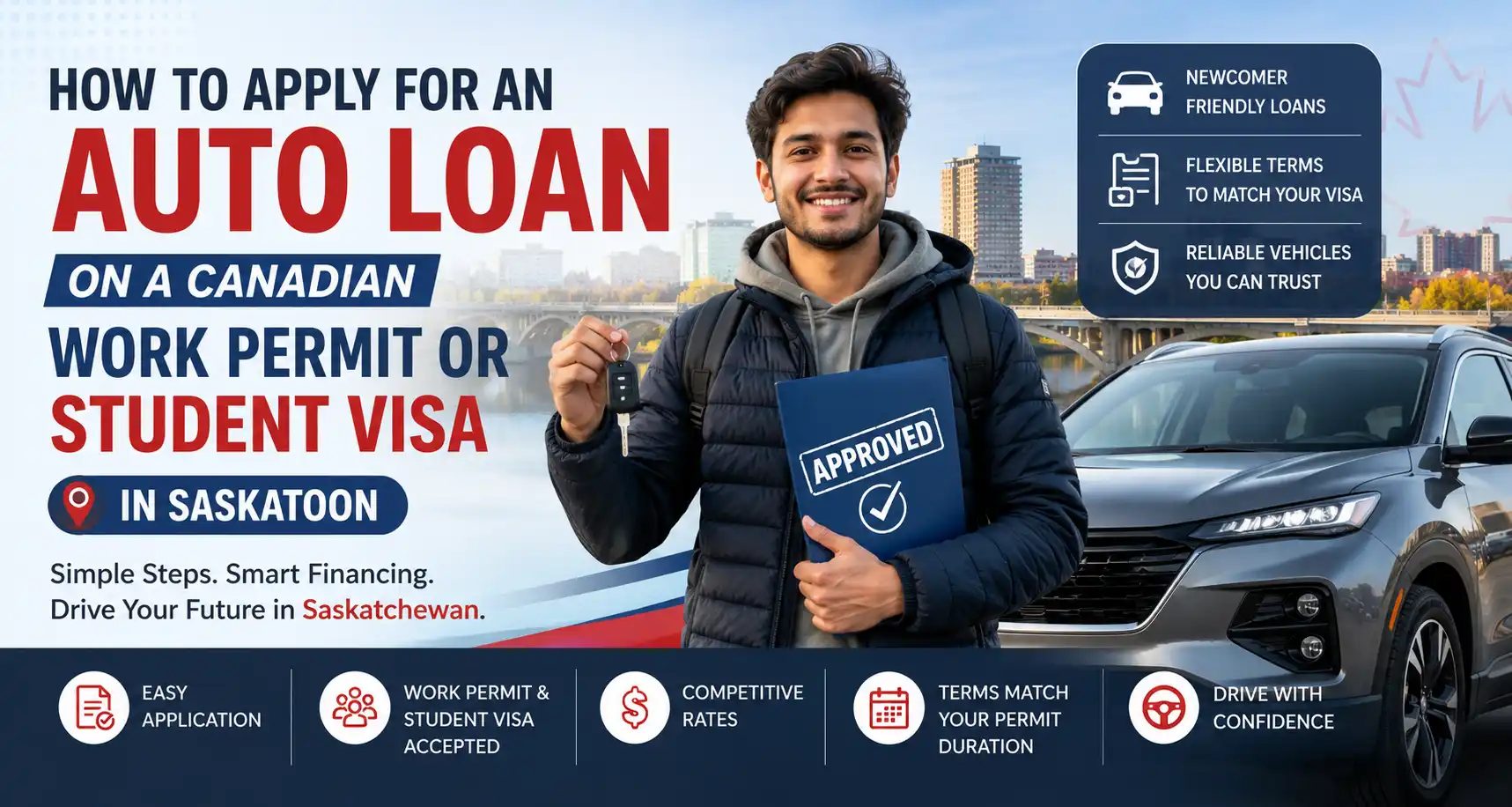
Moving to Saskatchewan as an international student or temporary foreign worker is an exciting journey, but navigating local transit systems without a personal vehicle can be a challenge during harsh Prairie winters. Securing reliable transportation makes commuting to the University of Saskatchewan or regional job sites significantly easier.
Many newcomers assume that financing a vehicle requires long-term permanent residency or a decade of local history. Fortunately, specialized financing pathways exist that allow temporary residents to purchase dependable transportation. Understanding the distinct documentation and lending parameters used across Saskatchewan ensures a seamless car-buying experience.
Can you get a car loan on a temporary Canadian visa?
Yes, temporary residents can secure a vehicle loan in Canada by matching their loan repayment term to the remaining duration of their active visa. Lenders require proof of legal residency status, stable local income, a valid social insurance number, and a Saskatchewan driver's licence.
| Eligibility Factor | Temporary Worker Requirement | International Student Requirement |
|---|---|---|
| Primary Document | Valid Work Permit (IMM 1442). | Valid Study Permit (IMM 1442). |
| Loan Term Limit | Must mature before the work permit expires. | Must mature before the study permit expires. |
| Income Verification | Full-time employment contract & pay stubs. | Part-time pay stubs or verified sponsor funds. |
| Down Payment | Recommended 10% to 15% to lower risk. | Recommended 15% to 20% to offset thin credit. |
Meeting these core parameters allows auto finance specialists to present competitive lending options tailored to your stay. Because traditional banks heavily favor applicants with established local profiles, matching your loan length directly to your legal stay parameters removes the primary hurdle faced by newcomers.
What documents do you need for a newcomer auto loan in Saskatoon?
To apply for an auto loan on a Canadian work permit or student visa in Saskatoon, you must provide your active immigration permit, a temporary Social Insurance Number starting with a 9, proof of local physical address, and official income verification.
- Immigration Documents: A clear physical or digital copy of your Citizenship and Immigration Canada (IRCC) permit.
- Identification: A valid Saskatchewan driver's licence or a compliant international driver's licence accompanied by a passport.
- Tax Documentation: Your 9-series Social Insurance Number (SIN) was provided by Service Canada upon entry.
- Income Verification: Your two most recent local pay stubs or an official employment letter confirming your hourly wage or salary.
- Proof of Residence: A local Saskatoon utility bill, active residential tenancy lease agreement, or official bank statement showing your local physical address.
Gathering these papers prior to visiting an auto dealership accelerates the pre-approval process. Auto financing partners rely on these documents to build a complete risk assessment profile, ensuring that temporary workers and students are matched with manageable monthly payments that respect their legal stay limitations.
Why does your permit expiry date dictate your loan terms?
Canadian auto lenders limit vehicle financing terms for temporary residents to ensure the loan balance is entirely paid off before the applicant's legal right to remain in the country expires. This policy minimizes structural default risks for the lending institution.
The Visa vs. Loan Maturity Rule
- Your Active Visa Timeline
This is your approved legal stay in Canada (e.g., 36 months remaining on a study or work permit).
🟩 Approved Safe Zone
Your auto loan term fits completely within your visa timeline. For example, a 24-month loan on a 36-month visa is safely approved because payments finish before your permit expires.
🟥 Denied Risk Zone
Your financing term extends past your legal stay. For example, asking for a 48-month loan on a 36-month visa triggers an automatic denial because the lender faces structural default risks.
The entire amortization schedule must squeeze neatly within that active thirty-six-month immigration window. This reality makes used vehicles an incredibly smart and practical financial decision for newcomers. Because pre-owned cars carry a lower total purchase price compared to brand-new models, the monthly payments remain realistic and affordable, even when compressed into a shorter two- or three-year repayment schedule.
Do you need a Canadian credit history to qualify?
No, temporary residents do not need an established Canadian credit score to qualify for a vehicle loan, as specialized newcomer financing programs evaluate local income and down payment size to determine applicant risk.
Building a localized credit profile takes time. New residents often encounter a frustrating hurdle where mainstream banks refuse automotive financing simply because the applicant's credit file is completely blank. Specialised automotive finance groups bypass this algorithmic barrier by looking at alternative signs of financial stability.
To strengthen your application when you lack a local credit profile, focus heavily on your debt-to-income ratio. Demonstrating that your monthly automotive obligations consume less than 30% of your gross earnings proves to underwriters that you can comfortably manage the asset. Additionally, maintaining a clean checking account free of overdraft fees over a consecutive 90-day window provides a strong trust signal during the manual underwriting process.
How does a down payment improve your approval odds?
A larger down payment improves approval odds for temporary visa holders by reducing the total loan-to-value ratio, which lowers the financial risk for the lender and decreases the borrower's monthly payment obligations.
- Lowers Loan Principle: Paying more money upfront reduces the total amount you need to borrow from the dealership's financial network.
- Reduces Monthly Budget Strain: Smaller loan balances mean your compressed monthly payments stay well within your local income limits.
- Offsets Credit Absence: Presenting cash upfront acts as immediate collateral, signaling to underwriters that you are financially committed to the asset.
- Minimizes Interest Accumulation: Borrowing less money overall saves you hundreds of dollars in interest charges over the lifespan of the car loan.
For international students operating under the standard 24-hour weekly off-campus work limit during regular academic semesters, keeping monthly expenses low is crucial. Contributing a larger down payment ensures that your compulsory monthly auto loan expenses do not conflict with your core educational costs or housing obligations.
What steps should you take to apply at Ovimotors?
To apply for an auto loan on a Canadian work permit or student visa in Saskatoon, you should gather your immigration permits, organize your local employment documentation, establish a budget, and submit a secure online pre-approval application.
First, calculate a realistic monthly budget that accounts for vehicle payments, mandatory Saskatchewan auto insurance, and fuel costs. Knowing your exact financial boundaries keeps your vehicle search focused and productive. Next, compile digital copies of your pay stubs, employment contracts, and your active IRCC temporary resident document packet.
Once your paperwork is organized, skip the stress of traditional bank queues by submitting a secure credit application directly through the Ovimotors finance department, or you can call us at (306) 801-6700. Our team reviews your temporary residency timelines and leverages a diverse network of regional lending institutions to secure an approval that fits your unique situation. We work hard to get you behind the wheel of a dependable vehicle quickly, allowing you to focus on your career or studies in Saskatchewan with complete peace of mind.
Frequently Asked Questions About Visa Car Loans in Saskatoon
1. Can I get a car loan if my work permit is being renewed?
Direct Answer: Yes, you can secure an auto loan during a permit renewal if you provide your official IRCC "Implied Status" letter alongside your expired permit and proof of ongoing Saskatoon income.
- Required Document: Official Immigration, Refugees and Citizenship Canada (IRCC) acknowledgment of receipt letter.
- Lender Requirement: Proof of stable, continuous local employment during the transition window.
- Financing Tip: Providing a larger down payment significantly increases approval odds during implied status.
2. Does getting a car loan help build my Canadian credit score?
Direct Answer: Yes, financing a vehicle through an authorized dealership is one of the fastest ways to build a Canadian credit score because your consistent monthly payments report directly to Equifax and TransUnion.
- Credit Impact: Demonstrates a consistent history of installment debt repayment to major bureaus.
- Best Practice: Always set up automated pre-authorized debit payments to avoid accidental late marks.
- Timeline: Most newcomers see a noticeable positive shift in their credit profile within six to nine months.
3. Can an international student buy a car from an inventory lot?
Direct Answer: Yes, international students legally attending a recognized institution like the University of Saskatchewan can buy and finance a reliable pre-owned vehicle if they meet basic income and visa parameters.
- Working Limit: Lenders review your current 24-hour weekly off-campus work limit to ensure payment safety.
- Alternative Income: Verified financial support from an international family sponsor can be used to strengthen applications.
- Smart Choice: Buying a high-quality used vehicle keeps compressed monthly payments affordable on a student budget.
4. What is the minimum down payment for a newcomer auto loan?
Direct Answer: There is no legal minimum, but a down payment of 10% to 20% is highly recommended for temporary residents to lower loan balances and bypass a lack of local credit history.
- No Credit History: A 15% upfront cash contribution acts as excellent collateral for specialized lenders.
- Lower Monthly Stress: Decreasing the principal balance keeps compressed short-term payments within your local monthly budget.
- Interest Savings: Borrowing less money overall significantly lowers the amount of total interest paid over the loan term.
Comments (0)
Leave a Comment
No comments yet. Be the first to comment!